
The Phoenix-RTOS-based autopilot for autonomous UAVs
Consolidate flight control, communication, and mission management onto a single hardware platform. Powered by Phoenix-RTOS for safety and reduced SWaP (Size, Weight, and Power)
Features
Complete System Framework
Complete software and hardware development framework facilitating the development of drones with edge processing.
Full sovereignty
Proprietary autopilot software built from scratch, running on hardware based 100% on EU and allied components.
OS-Driven Architecture
Software-defined modular and partitioned architecture based on the Phoenix-RTOS operating system.
Edge Applications
An edge application platform for autonomous missions—enabling real-time sensor fusion, swarm ops, and terminal guidance.
Phoenix-PILOT Promo Video
Flight control, communication, and mission control on the same hardware
General architecture

A single autopilot node is a computing system partitioned into
three core domains: Flight Control, Communication, and Mission
Control.
Software architecture
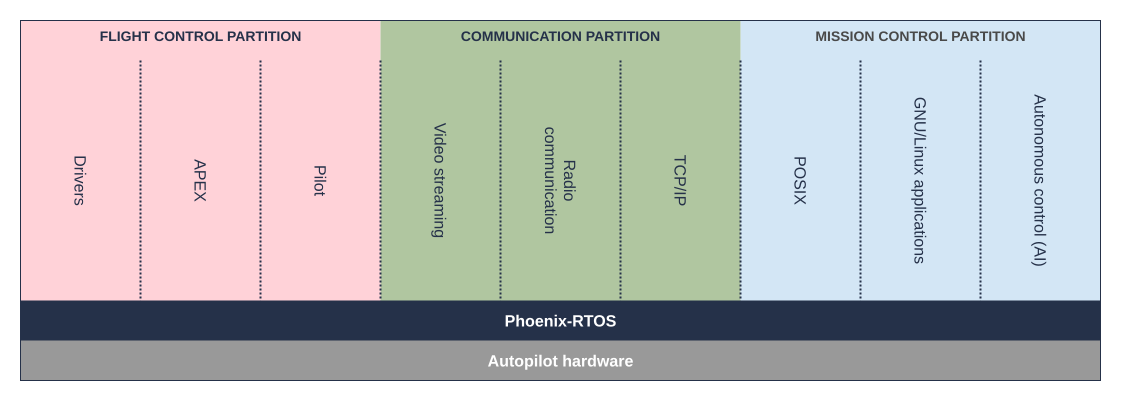
Phoenix-RTOS enables hardware-isolated process partitioning across diverse MMU and MPU architectures on a single system, seamlessly abstracting away underlying hardware nuances.
Hardware triplication for enhanced reliability
The autopilot is designed to operate in either standard or high-reliability configurations, the latter comprising multiple autopilot nodes. To best illustrate the core concept and overall model, this section focuses on the high-reliability variant.
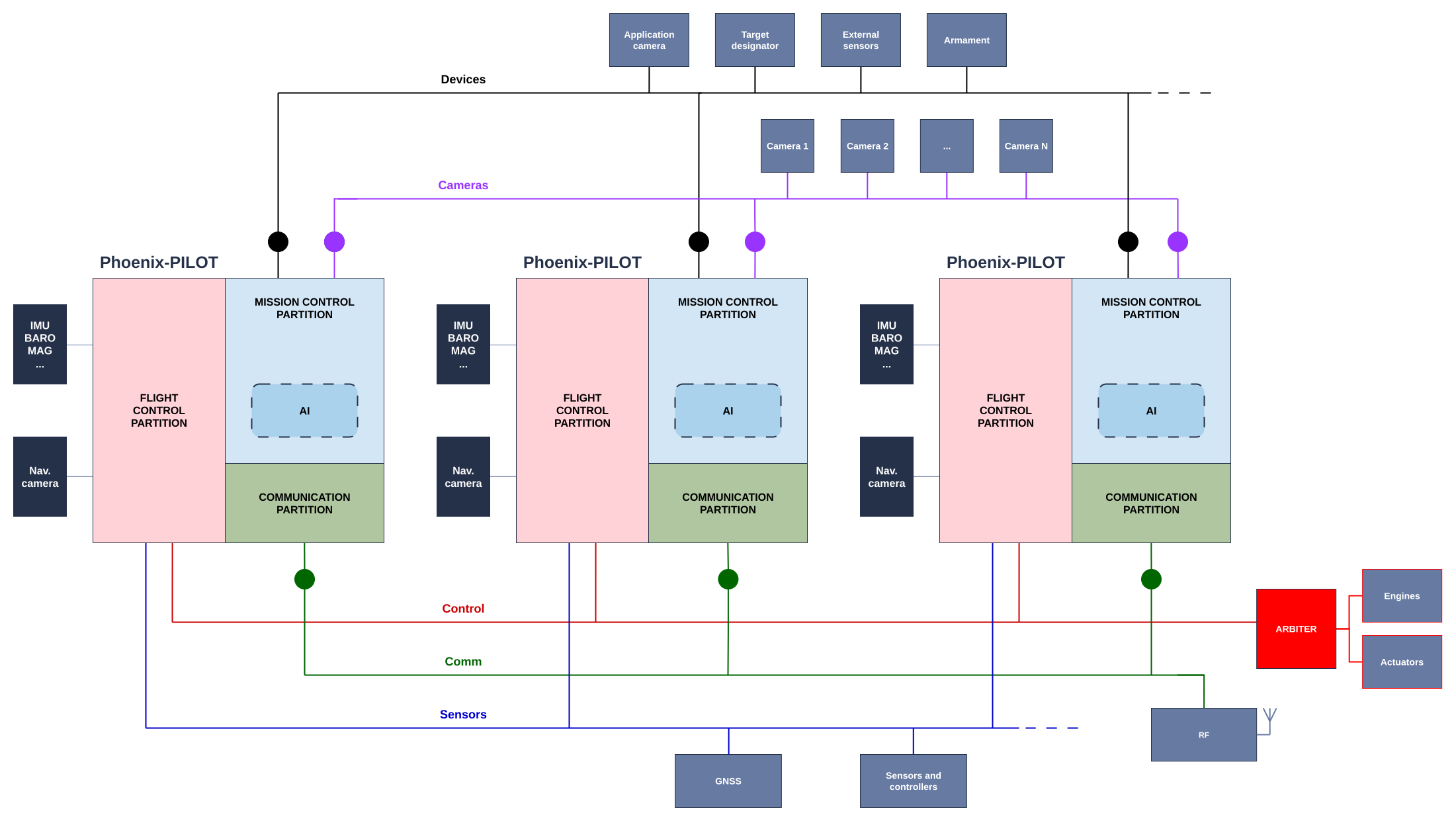
The Flight Control partition interfaces via the Control bus with other nodes and ultimately with the Arbiter, which drives the flight control
effectors—namely motors or control surfaces.
The autopilot units function in a synchronous manner, cross-sharing data from specified sensors. The Arbiter evaluates the effector commands generated by all nodes and executes control based on a majority decision.
The Arbiter designates the lead node for mission control, granting it exclusive rights to receive operator commands, process data via edge analytics (e.g., target detection), and interface with peripherals.
Components framework
Software
- Phoenix-RTOS: Core real-time operating system managing the autopilot hardware.
- Autopilot Logic: Continuously processes sensor inputs to calculate necessary motor adjustments for maintaining stability, following waypoints, and executing autonomous flight paths.
- Mission Planner: Enables designing autonomous flight paths and the execution of predefined tasks.
- Artificial Intelligence: Object recognition and following, self-awareness, autonomous decision-making and mission control.
- User applications: User-created applications running in parallel to the autopilot and utilizing hardware resources.
Hardware
- Core Computing: High-performance ARM Cortex-M/A/R Series chips to run real-time flight control loops, sensor fusion, navigation algorithms, and user applications.
- Sensor Suite: Variety of sensors including IMU, barometer, magnetometer, GNSS measuring environmental conditions, spatial orientation, and movement allowing for stable flight and precise navigation.
- Power Management Unit: Monitors battery voltage, regulates stable power distribution to onboard electronics, and feeds real-time power telemetry to the flight controller.
- Communications & I/O Interfaces: Connectors and interfaces ready to support RC and GNSS receivers, VTX control, ESC and MAVLink telemetry, Optical Flow sensors, and others.
Hardware versions
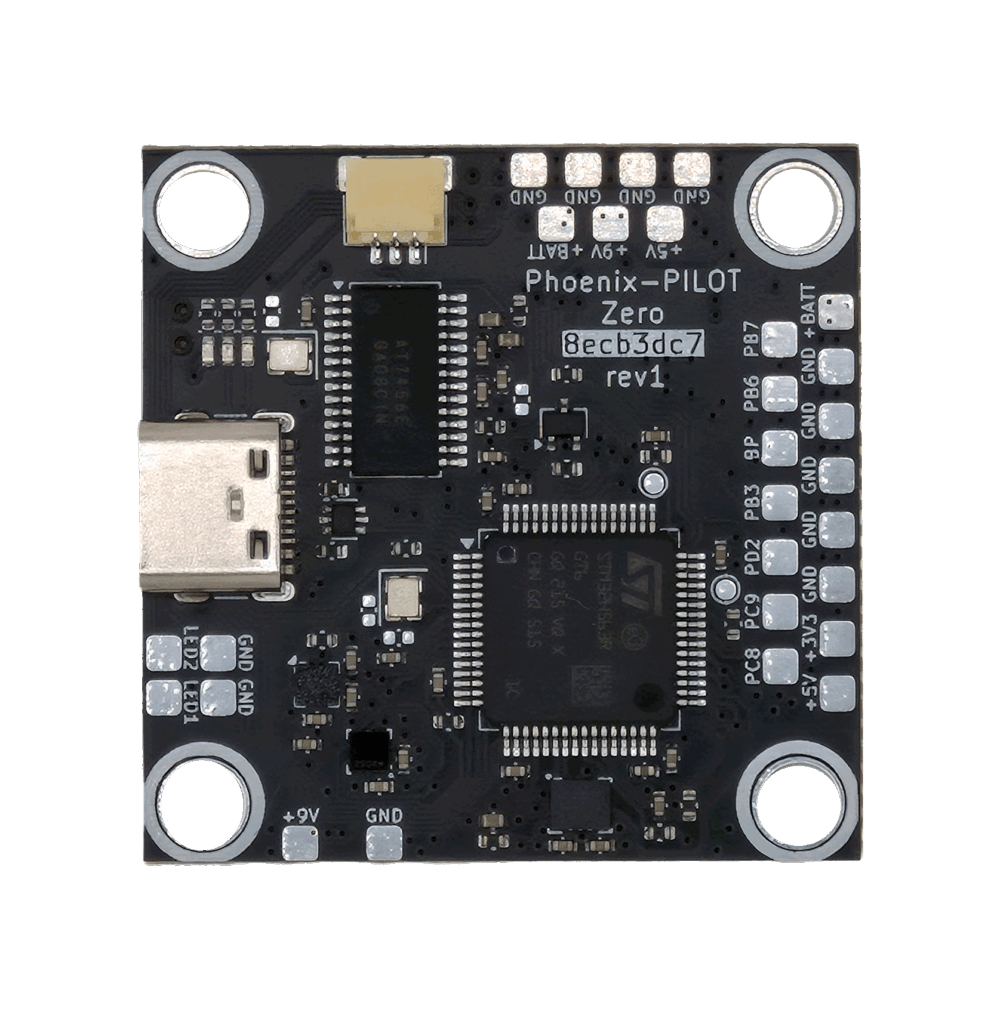
Phoenix-PILOT Zero
for regular FPVs
–
BOM cost: 20 EUR
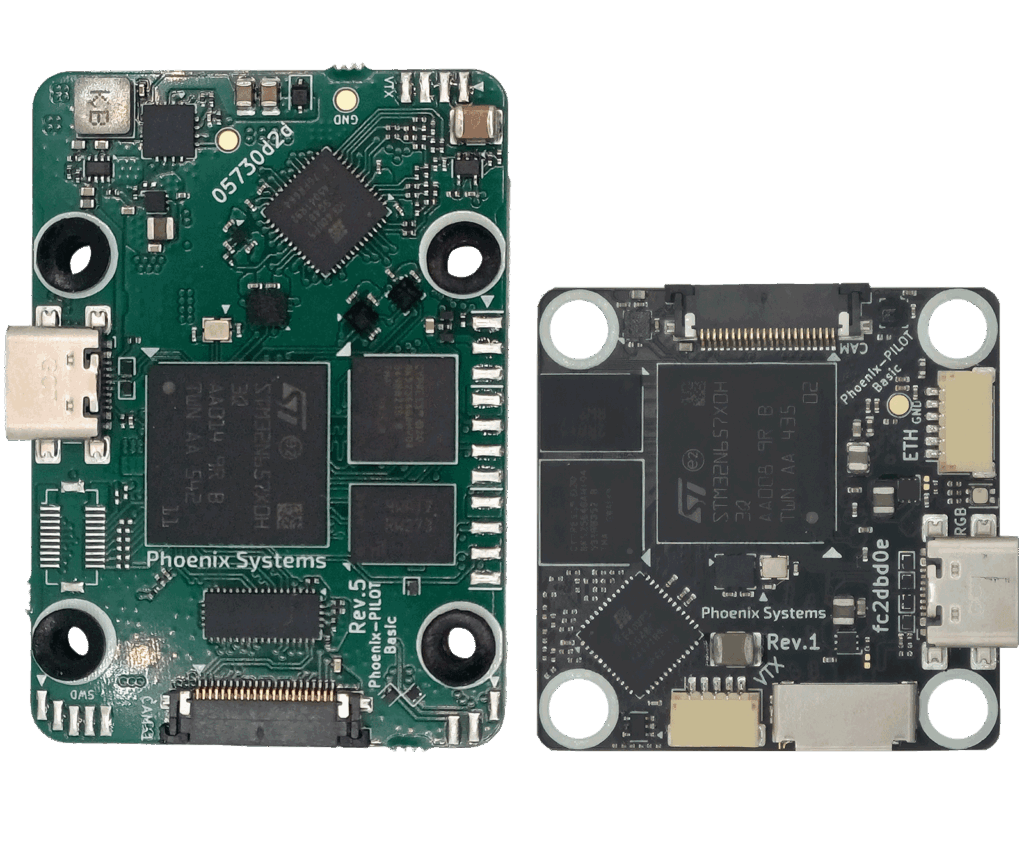
Phoenix-PILOT Basic
for smart FPVs
up to 2 digital cameras
1xCPU + NPU (0.6 TOPS)
BOM cost: 80 EUR
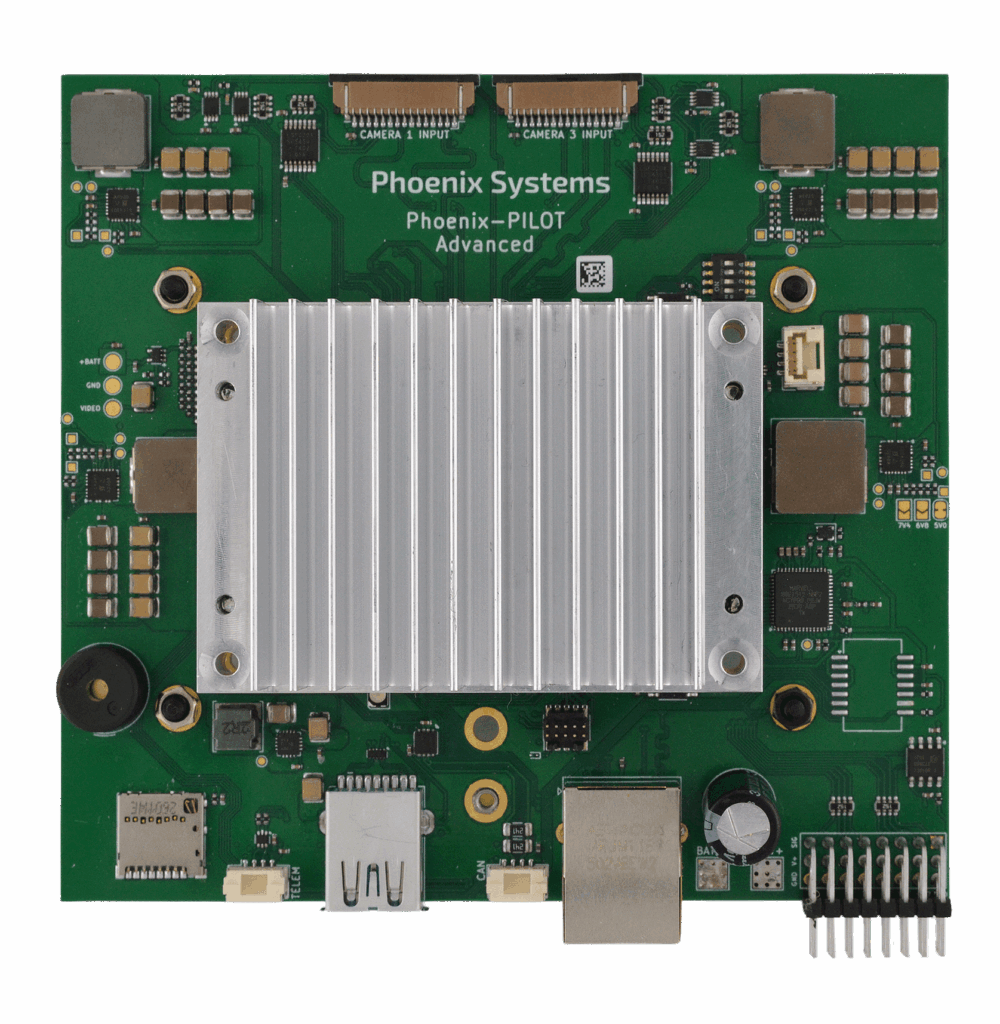
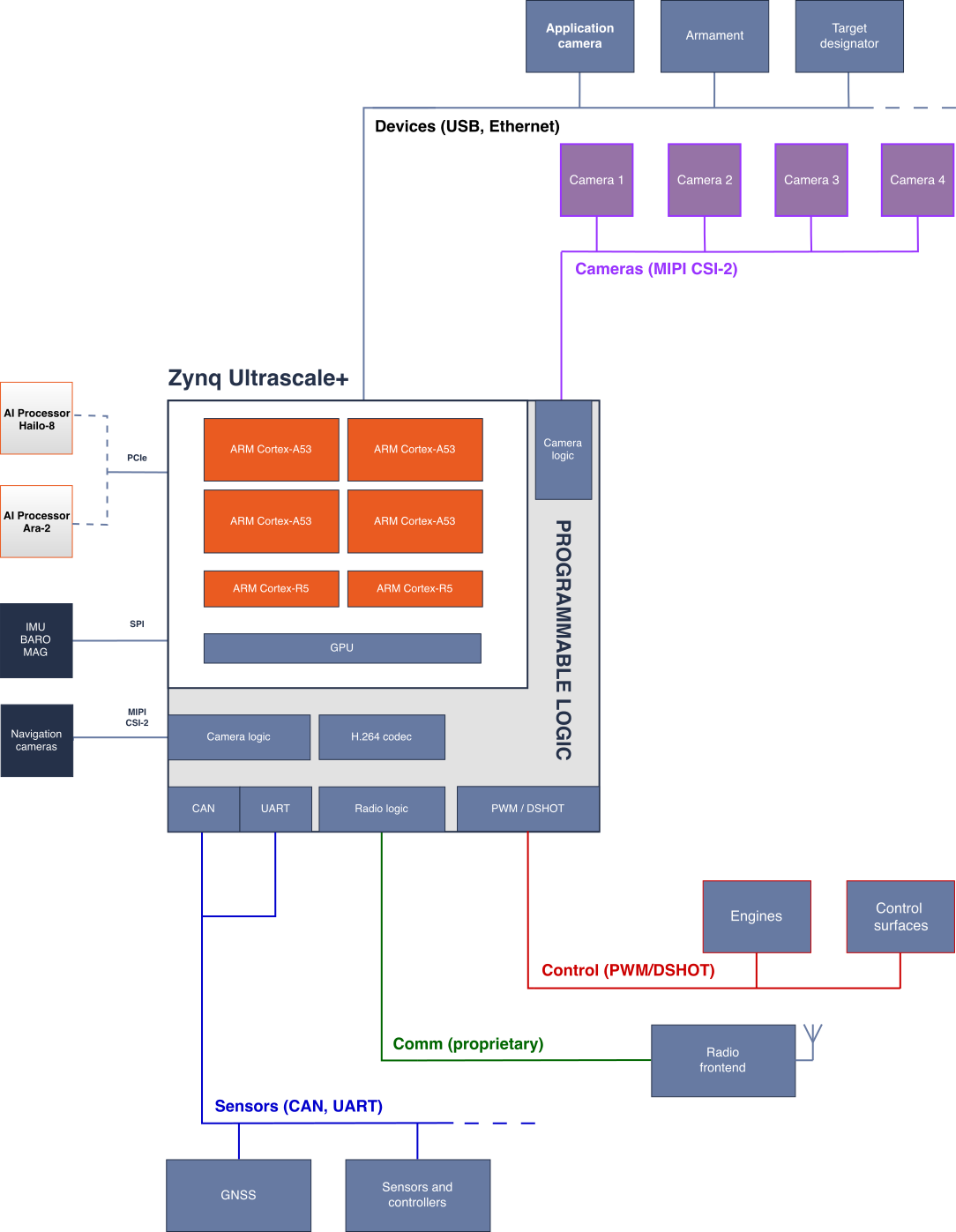
Phoenix-PILOT Advanced
for high-performance UAVs
up to 4 digital cameras
4xCPU + FPGA + NPU (up to 214 TOPS)
BOM cost: 500 EUR
Technical details
| Target use | Low cost FPV’s |
| Control | Up to 4 engines or payload control channels |
| AI capabilities | – |
| Number of cameras | – |
| Synchronous camera usage | No |
| Camera types | – |
| Video processing | – |
| External interfaces | 1x I2C, 4x UART, 1x USB 2.0 FS |
| ESC connection | PWM/DSHOT |
| Mounting | 30.5 x 30.5 mm mount standard |
| MAVLink support | Yes |
| RC control support | SBUS/CRSF/GHST |
| Triplicated setup | – |
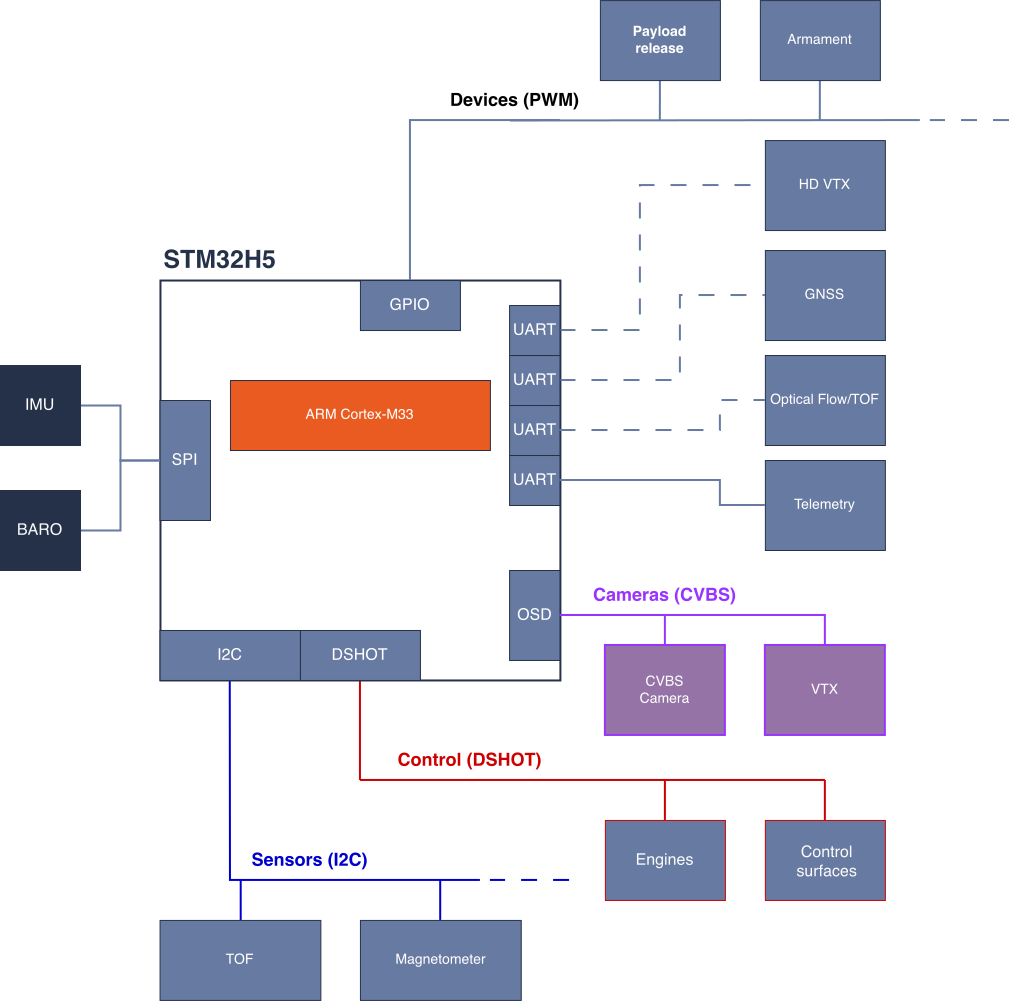
| Target use | Smart autonomous FPVs |
| Control | Up to 4 engines, and three control PWM channels |
| AI capabilities | Up to 0.6 TOPS (CPU-integrated), target following |
| Number of cameras | 2 digital cameras (via MIPI CSI-2) |
| Synchronous camera usage | No |
| Camera types | RGB, SWIR, LWIR |
| Video processing | H.264 codec, simple GPU |
| External interfaces | 1x I2C, 1x CAN, 6x UART, USB 3.0, Ethernet, MIPI CSI-2 |
| ESC connection | PWM/DSHOT, CAN |
| Mounting | 30.5 x 30.5 mm mount standard |
| MAVLink support | Yes |
| RC control support | SBUS/CRSF/GHST |
| Triplicated setup | Possible, for hazardous environment operation, enhancing fault tolerance |
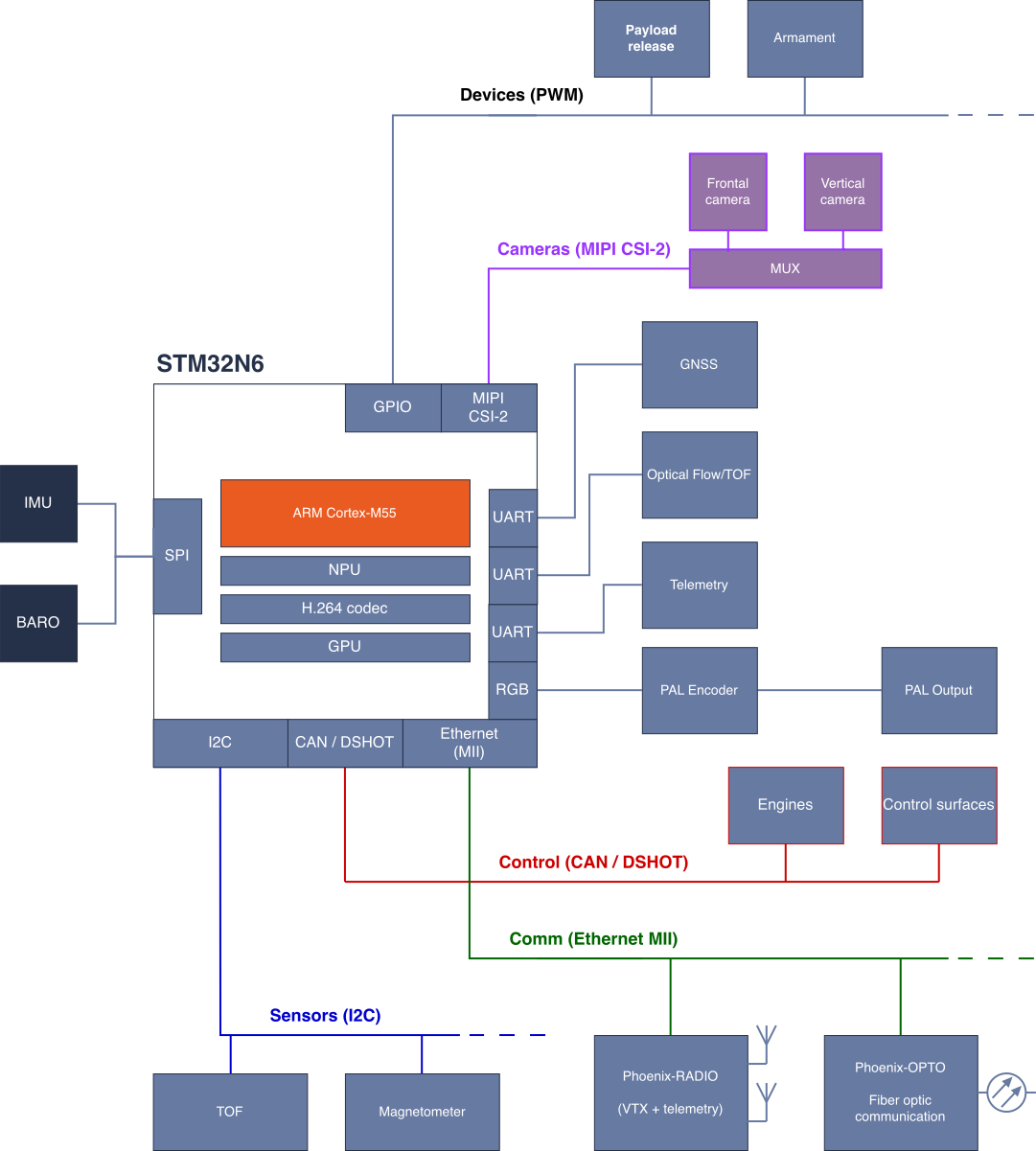
| Target use | High performance, multipurpose autonomous unmanned vehicles, for critical applications including: defense, logistics, industrial, inspection & mapping |
| Control | Up to 8 engines or payload control channels |
| AI capabilities | Up to 214 TOPS (Kinara Ara-2, Hailo-8 or Axelera AI Metis) object recognition and following, self-awareness, autonomous decision and mission control |
| Number of cameras | Up to 4 digital cameras (via MIPI CSI-2), totaling up to a 4k resolution |
| Synchronous camera usage | Yes |
| Camera types | RGB, SWIR, LWIR |
| Video processing | H.264/H.265 codec, GPU, FPGA |
| External interfaces | 2x CAN, 2x UART, USB 3.0, Ethernet, MIPI CSI-2 |
| ESC connection | PWM/DSHOT, CAN |
| Mounting | Custom housing |
| MAVLink support | Yes |
| RC control support | SBUS/CRSF/GHST |
| Triplicated setup | Possible, for highest safety rating in critical applications |
Licensing & Source Access
Phoenix-PILOT is provided as a production-grade set of software packages and hardware projects tailored for seamless development. The framework is delivered under a straightforward commercial model based on three core components:

Source Code License
Provides your engineering team with 100% visibility and full access to the core framework codebase enabling you to freely develop, customize, port to new hardware, and perform zero-trust security or compliance audits.

Per-Device License
A scalable, volume-based production fee applied to each active unit deployed in the field. Depends on annual volume prospects.

Support Fee
An ongoing maintenance and technical support fee that guarantees your project continuous access to software updates, security patches, protocol revisions, and direct engineering backing from our team.
Resources & Documentation
Phoenix-PILOT Product Brief – A brief summary of Phoenix-PILOT core objectives, key features and target use.
Phoenix-PILOT Product Architecture – A high-level technical overview including deployment topology and hardware matrices.
Phoenix-PILOT Basic User Documentation (PL) – Comprehensive user documentation for the Phoenix-PILOT Basic autopilot system.
Phoenix-PILOT Basic PPBS Hardware Architecture (PL) – Documentation of the hardware architecture of the Phoenix-PILOT Basic PPBS flight computer.
Phoenix-PILOT Basic PBBK Hardware Architecture (PL) – Documentation of the hardware architecture of the Phoenix-PILOT Basic PBBK flight computer.
Phoenix-PILOT Application Execution Environment – Technical manual describing API and methods for developing edge applications.
Phoenix-PILOT-based UAVs
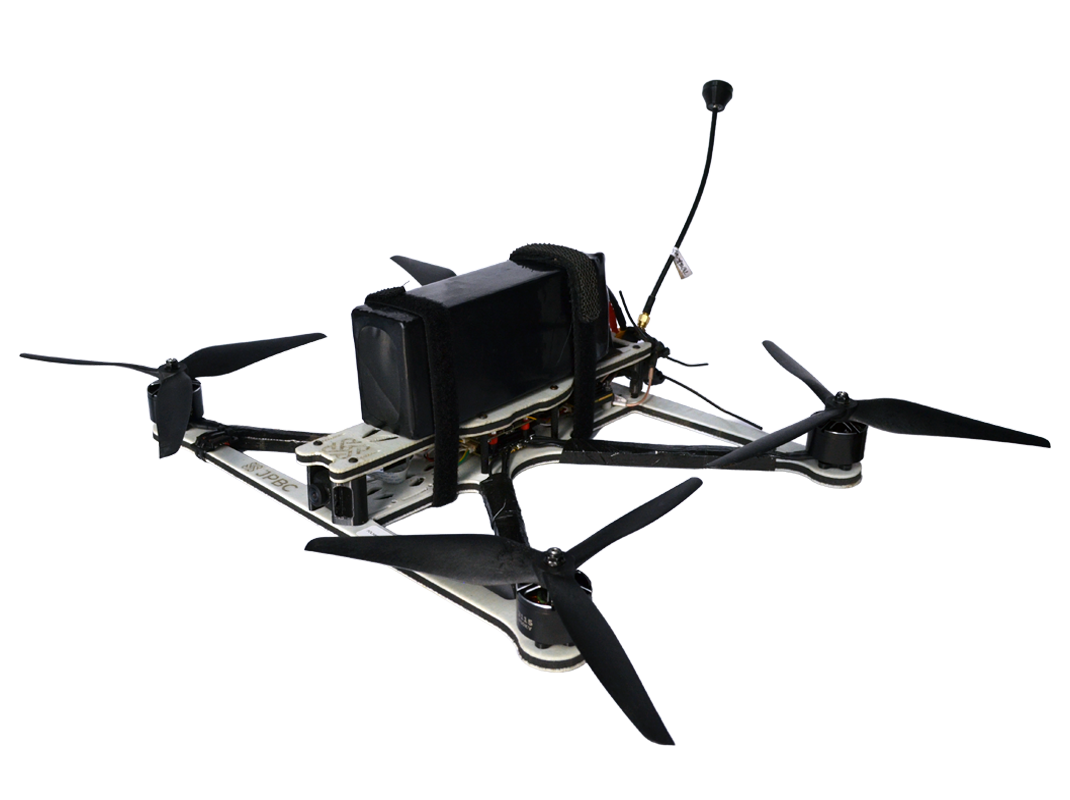
OWLFPV-10
V-max: 125 km/h
Range: up to 20 km
Flight time: up to 50 min (no payload)
Payload: max 2.8 kg
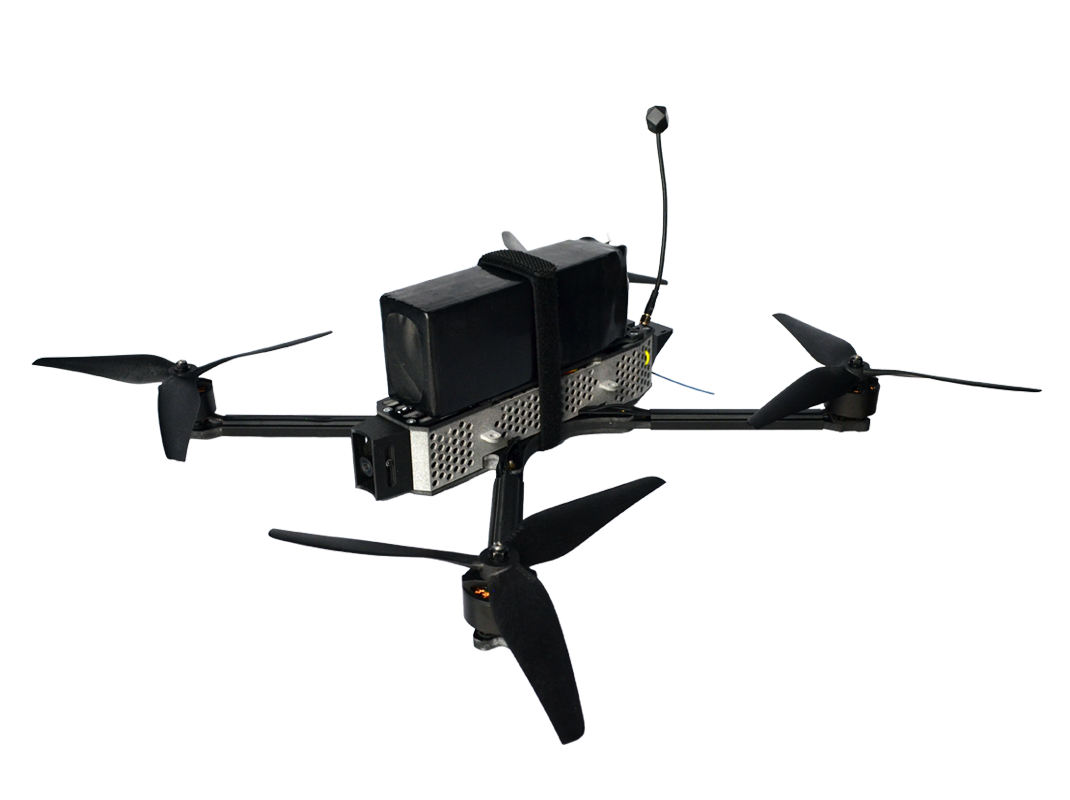
Punktor
V-max: 140 km/h
Range: up to 12 km
Flight time: up to 50 min (no payload)
Payload: max 3.5 kg
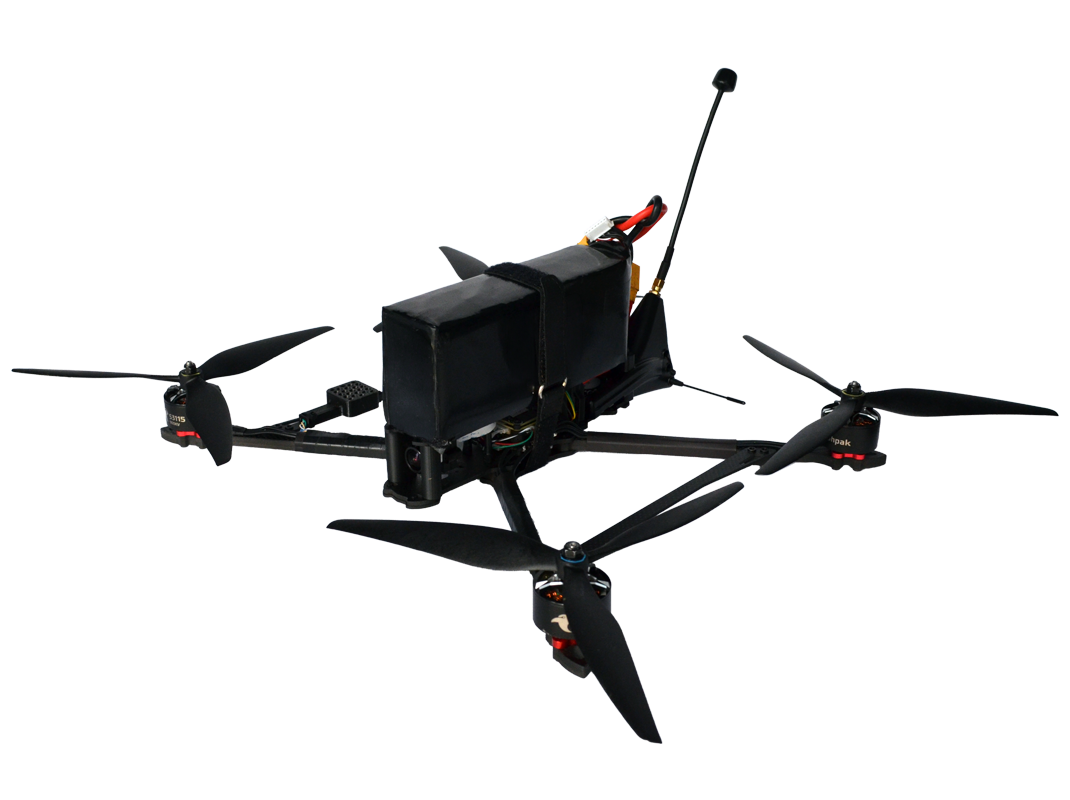
Shpak
V-max: 150 km/h
Range: up to 20 km
Flight time: 15 min (2 kg payload)
Payload: max 5 kg
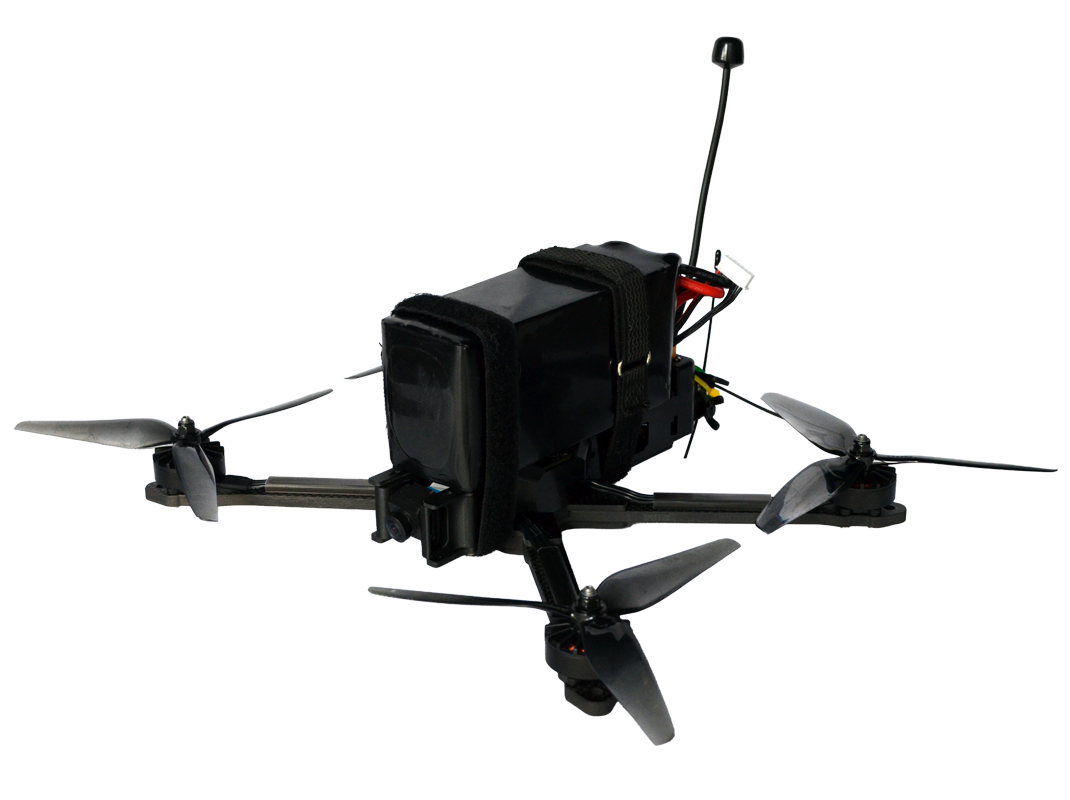
VPL7
V-max: 120 km/h
Range: up to 5 km
Flight time: 15 min (2 kg payload)
Payload: max 2 kg
Contact & Business Inquiry
Looking to build your new drone based on the Phoenix-PILOT framework? Get in touch directly with our team to discuss your project requirements.

Marcin Wilczyński
Product Manager
pilot@phoenix-rtos.com