Phoenix-METER
complete software and hardware Phoenix-RTOS-based development framework for Smart Energy Meters
What’s in it?
Reference 1-phase or 3-phase meters with Power-Line Communication (PRIME, G3-PLC), IEEE 802.15.4 communication (Wireless M-Buss, ZigBee), USB interface for connecting external communication modems (4G, 5G, WiFi).
What’s in it?
- Reference 1-phase or 3-phase meters with Power-Line Communication (PRIME, G3-PLC), IEEE 802.15.4 communication (Wireless M-Buss, ZigBee), USB interface for connecting external communication modems (4G, 5G, WiFi).
- Complete firmware including Phoenix-RTOS operating system, communication stacks (PRIME. G3-PLC for CENELEC and FCC, TCP/IP), USB stack with device drivers, metrology, DLMS/COSEM server and sample application.
- Complete hardware design including schematics and PCB layout.
Innovative flexibility on a solid foundation
Phoenix-SEM Development Framework is a field-proven, commercially available solution. Software-defined approach enables fast development of metering application on low-resources platforms and unique flexibility in terms of meter’s functionalities delivered to end-customer.
You choose a set of components included in Phoenix-SEM that meets the functional requirements of your project and capabilities of the hardware platform.
Adapt, extend, develop
ADAPT: Phoenix-SEM allows software extensibility facilitating updates and enabling adaptation of functionalities to changing requirements thanks to hight scalability of the Phoenix-RTOS microkernel architecture and its partitioning, inter-process communication and system resources management mechanisms.
EXTEND: Phoenix-SEM supports a whole range of different communication protocols to choose from depending on the characteristics of the hardware platform (TCP/IP, USB, Wireless M-Buss, IEEE 802.15.4) enabling external communication with third parties thanks to availability of dedicated interfaces and implemetation of communication stacks.
DEVELOP: Phoenix-SEM provides a secure, system-isoleted environments for execution of additional DSO and user applications and facilitates their self-development thanks to Phoenix-RTOS support for programming languages C, C++, Python, microPython and its status of an open-source with libraries available on GitHub.
Why „smart” ⇔ „software-defined”?
- Modular solution with high scalability facilitating updates and enabling adaptation of functionality to changing requirements
- Environment for running user applications providing further extension of funtionality – Phoenix-RTOS supports languages: C, C++, Python, microPython
- Partitioning mechanism guaranteeing a secure separation of user’s applications space and legally relevant DSO’s space dedicated to metering functionality
- Mechanisms of resource management, security, encryption etc. facilitating work and shortening product’s Time To Market
- Implementation of functionality directly in software instead of hardware, minimizing the cost of a single device’s production
Discover Phoenix-SEM software architecture
- High scalability of the microkernel-based Phoenix-RTOS operating system makes it provide application environment similar to the general-purpose OS environment when being run on devices with limited computing resources – using only KB of RAM deployed on 2 processor cores (ARMv7 Cortex M7, ARMv7 Cortex M4).
- Space divided into DSO partition, including legally relevant MID-certified metrology, and system-isolated user partition dedicated to user applications execution guarantees secure separation at the software level.
Components:
- MID-certified metrology with change verification and secured firmware upgrade components
- PLC PRIME 1.3.6 and G3-PLC standard implementation (CENELEC and FCC) optimized for limited hardware resources
- DLMS / COSEM data model in accordance with the DSOs remote reading outlines
- TCP/IP stack providing possible further extention of functionality
- Environments for running DSO and user applications with supported languages: C, C++, Python, microPython.
- USB stack with device drivers enebling usage of external communication modems (4G, 5G, WiFi)
- Supported low-level drivers (e.g. SPI, GPIO, UART)
Available reference design kit
besmart +1
Future belongs to Smart Energy Meters
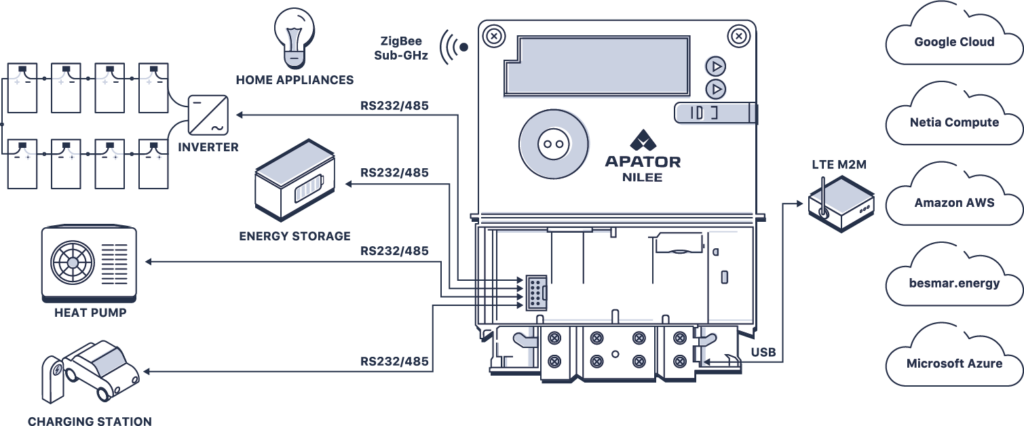
Smart Energy Meter can act as a real-time energy assistant which, based on the analyzed data, effectively manages energy-intensive devices (e.g. heat pumps, EV chargers), inverters and energy storages communicating directly with the Cloud energy management platform and enables further extension of functionality by hosting users apps.
Phoenix-DCU
complete software bla bla który czyta miliony na Twoim hardware i może na Phoenix-RTOS, i na GNU Linux, a także w chmurze
What’s in it?
DCU application,
metrology,
PLC communication
networking
security extentions
intuitive GUI
advanced analitics
multiple OS support
Why?
field-proven 3 koncentratory pełne + 2 porty na urządzenia klienta (wymienić nazwy + linki case studies),
PRIME 1.3.6. CENELEC A, PRIME 1.4. BC CENELEC A, PRIME 1.4. w paśmie FCC certyfikowany w kanałach 1 do 8 (-2)
JEDYNY CERTYFIKOWANY multiple-channel support
+ linki do certyfikatów
cloud version using DLMS PRIME Base Node gateway for Phoenix-RTOS enabling to launch DCU functionality on regular smart meter
software-defined communication stacks
multiple analog frontend support (TI AFE031, TI AFE032, NJM45001, ATPL220A)
multiple COSEM model support
modular and extensible
PRIME certification toolkit
Technical details
meter data gathering: automatic meter readout with caching
meters limit: 2048
meter communication: DLMS/COSEM client with security support
meter firmware upgrade: unicast and broadcast support
meter data storage: SQL database for meter data
network protocols: HTTP / HTTPS TLS 1.2, SSH, Telnet, DCSAP, NTP, DHCP, SNMP
network security: 802.1x, IPSec, OpenVPN, WiFi WPA2, device certificate management
metrology: software-defined 3-phase extensible meter application
metrology class: C
PLC communication: PRIME 1.3.6 CENELEC A, PRIME 1.4 BC CENELEC A, PRIME 1.4 FCC, G3-PLC CENELEC A/FCC software-defined (wszystkie)
PLC diagnostics: PLC spectrum analyzer, PLC sniffer with WireShark support,
PLC advanced features: multichannel support with dynamic band selection for optimal communication
implementation: C language using POSIX API with minimal footprint
implementation platform: Phoenix-RTOS, GNU/Linux
Architecture
grzebyk + co jest
Discover intuitive GUI (galeria)
What’s next?
product presentation, project definition, joint development, certification deployment support