
The Phoenix-RTOS-based software-defined satellite reference design
Reference Software-Defined Satellite based on Phoenix-RTOS and high-performance RISC-V and SPARC SoC
Features
Mission Ready Software-Defined CubeSat 6U Platform
A reference 6U CubeSat platform powered by Phoenix-RTOS, pre-configured for Earth observation and telecommunication applications powered with AI.
Based on state-of-the-art high-performance RISC-V SoC
Rad-Hard variant, for the most severe environment, developed in collaboration with Frontgrade Gaisler offers the new GR765 SoC (up to 8 NOEL-V RISC-V or SPARC V8 cores); and a Rad-Tolerant variant, based on COTS RISC-V SoC with in-house Fault Tolerant features for ensuring the highest possible reliability.
Software-defined satellite modules
All critical satellite modules (e.g. ADCS controller, TCTM engines) are implemented as software applications executed under control of
Phoenix-RTOS.
On-Board Edge AI
Supercharge your scientific and industrial applications with powerful edge AI processing with PCI-E and DMA-based fast interface.
Edge applications
Scalable architecture utilizing Phoenix-RTOS allows you to easily extend satellite functionality during its operations.
Satellite Architecture
The schema below presents satellite architecture
Power Supply Unit
Stores, manages, and distributes electrical power (e.g., from solar panels) to all subsystems.
Attitude Determination and Control
Determines and controls the satellite’s spatial orientation using a set of sensors and actuators.
Communication Unit
Handles two-way radio communication with Earth for telecommands (TC) and telemetry (TM).
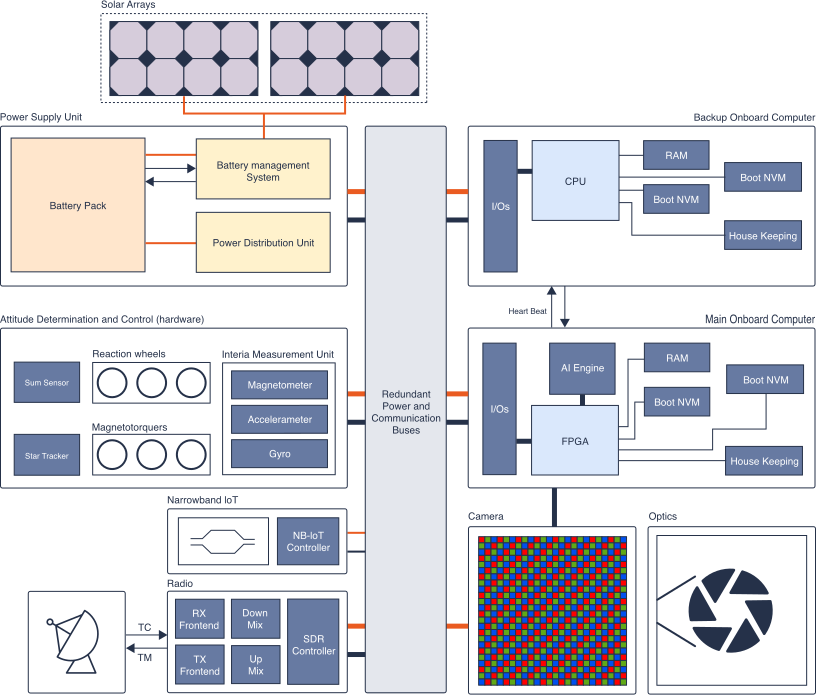
Backup Computer
Takes over critical control functions to maintain operations if the main computer fails.
Main Computer
Centrally manages all systems, executes mission tasks, and performs advanced AI data processing. Key components run as software modules managed by Phoenix-RTOS.
Payload (e.g. Camera)
Executes core research or commercial mission objectives, such as capturing high-resolution optical data.
Main Computer Hardware and Software
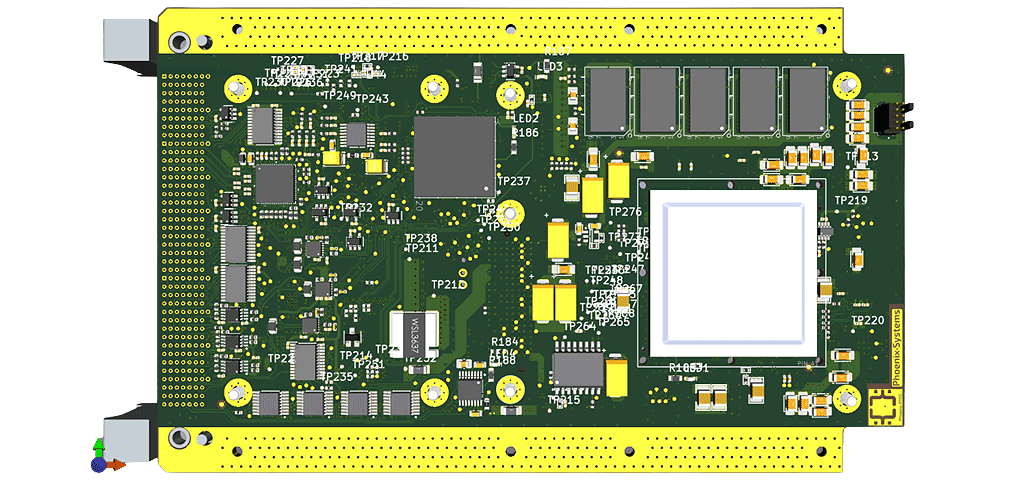
The Main On-Board Computer (MainOBC) provides a scalable, high-performance computing platform engineered to balance mission requirements, radiation environment severity, and cost efficiency. The hardware is available in two distinct configurations:
- Radiation-Tolerant Variant: optimized for cost-sensitive missions, featuring a Commercial-Off-The-Shelf RISC-V System-on-Chip integrated with a custom FPGA and software-level Fault-Tolerant mitigation extensions.
- Radiation-Hardened Variant: designed for deep-space environments and critical operations, utilizing the space-qualified Frontgrade Gaisler GR765 SoC to ensure maximum Single-Event Effect immunity and high Total Ionizing Dose tolerance.
The platform incorporates a robust, high-reliability non-volatile memory sub-system dedicated to safe Flight Software storage and execution and payload data. Hardware functionality can be customized via an onboard FMC expansion connector. External communications rely on software-configurable differential links supporting SpaceWire, Ethernet, or proprietary custom interfaces, while a dedicated FPGA-based system controller provides real-time system monitoring and hardware watchdog functionality. Everything is packed in a single SpaceVPX card that can be integrated into nanosatellites like the reference 6U CubeSat or big platforms and service modules.
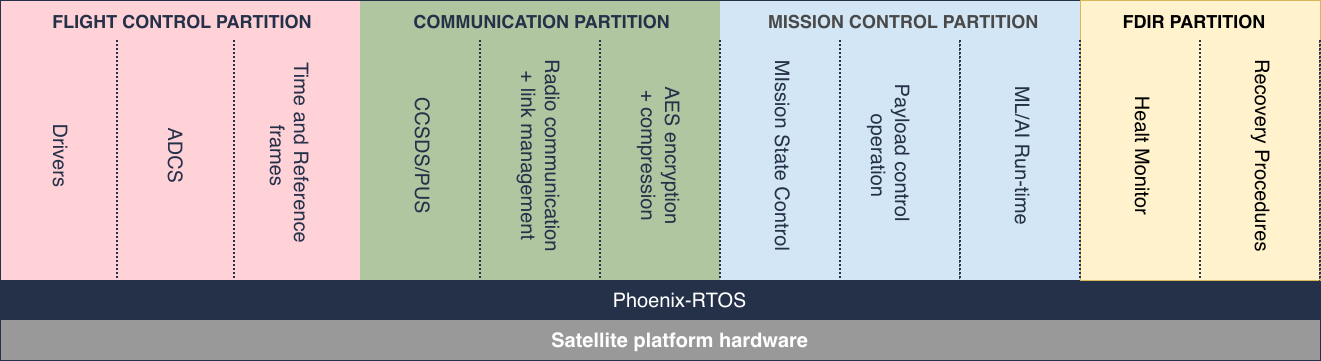
Built upon the microkernel-based Phoenix-RTOS, the Flight Software utilizes a strictly partitioned, modular architecture designed to deliver fault isolation, real-time determinism, and high mission availability. Operating directly over the satellite platform hardware, the FSW isolates critical spacecraft functionality across four independent operational domains:
FDIR Partition: Contains dedicated Fault Detection, Isolation, and Recovery (FDIR) mechanisms, continuously running health monitors and automated recovery procedures to safeguard the platform against anomalous system behavior.
Flight Control Partition: Contains low-level hardware drivers, the Attitude Determination and Control System (ADCS) processing engine, and precise time management with reference frame propagation routines.
Communication Partition: Manages telecommand and telemetry (TM/TC) processing adhering to CCSDS and ECSS PUS standards, radio link management, and hardware-accelerated AES encryption and payload data compression/decompression pipelines.
Mission Control Partition: Orchestrates top-level mission state management, payload operational workflows, and edge processing via an integrated ML/AI run-time environment.
Framework components
Complete HW design
Maximum mission success with hardware and software-level redundancy schemes designed for the most challenging environments.
Complete SW
Easily manage and respond to software-detectable faults. Define your desired system response through a well-organized Fault Detection, Isolation, and Recovery configuration table.
Robust Simulation and Testing Tools
Conduct extensive Software-in-the-Loop and Hardware-in-the-Loop testing in a high-fidelity simulated space environment to ensure mission readiness.
Example applications
Autonomous Edge-IoT satellite
Engineered for real-time orbital edge computing, this mission profile executes onboard data processing directly on payload data, e.g. high-resolution Earth Observation imagery, eliminating the need to downlink massive volumes of raw data. The flexible processing pipeline supports custom AI/ML inferencing, super-resolution enhancement, feature extraction, and automated event detection, transmitting only actionable intelligence and lightweight IoT telemetry to the ground.
NTN 5G gNodeB on LEO
Designed as an orbital 5G Non-Terrestrial Network (NTN) access node, the payload integrates Software-Defined Radio platforms running 5G gNodeB software stacks alongside dedicated IoT communication front-ends. The system supports a Store-and-Forward operational mode, reliably ingesting data from distributed ground sensors, buffering it securely in onboard non-volatile memory, and forwarding it to ground station gateways during downlink passes.
Space computing node
Configured for high-throughput orbital processing, the payload hosts a cluster of secondary compute nodes mirroring the MainOBC architecture. Interconnected via high-speed, low-latency PCIe links, each node can be customized with dedicated hardware AI accelerators or extended memory modules. High-performance workloads and computational tasks are dynamically dispatched across the cluster, allowing the spacecraft to serve as a high-density processing node within a larger, distributed satellite constellation.
Technical details
| Target Use: | High-performance, low-cost, software-defined microsatellites, including CubeSats. |
| Hardware: | Redundant system bus implemented via CAN, SpaceWire, SpaceFibre, or Ethernet. |
| Typical Application: | Earth observation with 10m or better Ground Sample Distance (GSD). |
| Reference System: | A fully-featured 6U CubeSat equipped with a Main and Backup On-Board Computers, featuring the RISC-V or SPARC SoC. |
| AI Capabilities: | PCI-E + DMA compatible edge processing, delivering up to 26 TOPS with Hailo-8. (planned support for Frontgrade Gaisler GR801 and Axelera Metis). |
| Space Protocols: | CCSDS, ECSS PUS, SpaceWire (including RMAP), SpaceFibre and CSP. |
| Housekeeping: | Configurable monitoring loop with user-defined sources and thresholds for current, voltage, and temperature events, using data from SPI or JESD-compatible A/D converters. |
| Radio: | UHF and S-Band antennas and transceivers with up to 4Mbps in low-power and 40Mbps in high-power configurations. |
Licensing & Source Access
Phoenix-SAT is provided as a production-grade set of software packages and hardware projects tailored for seamless development of next-generation satellites and space computing nodes. The framework is delivered under a straightforward commercial model based on three core components:

Source Code License
Provides your engineering team with 100% visibility and full access to the core framework codebase, software packages, and SDK tools. This allows your team to freely develop, customize, port to new hardware, and perform independent zero-trust security or compliance audits.

Per-Device License
A scalable, volume-based production fee applied to each active unit deployed in the field.

Support Fee
An ongoing maintenance and technical support fee that guarantees your project continuous access to software updates, security patches, protocol revisions, and direct engineering backing from our core architecture team.
Resources & Documentation
Phoenix-SAT Product Brief – A high-level technical overview including deployment topology and hardware compatibility matrices.
Software and Hardware Architecture Whitepaper – Deep-dive documentation on Phoenix-SAT architecture.
Application Execution Environment – Technical manual discussing API and methods for developing edge applications.
Contact & Business Inquiry
Looking to build your new satellite based on the Phoenix-SAT framework? Get in touch directly with our team to discuss your project requirements.

Aleksander Hernik
Product Manager
sat@phoenix-rtos.com